






NEWS
Grain Loader Specifications: What to Check Before You Buy
Contents
1. Bucket Capacity: How Much Grain Fits in Each Load?
2. Dump Height: Can the Bucket Tip Above the Receiving Point?
3. Bucket Interior: Does All the Grain Empty Out?
4. Turning Space: Work Within the Aisles Left by the Grain
5. Cleaning Access: Can Grain Dust Be Reached for Removal?
Before you commit to a grain loader, you need to know how it will work in your store. At LUYU, we put this grain loader buying guide together to explain the key specifications and help you explore the configurations available in our range.
1. Bucket Capacity: How Much Grain Fits in Each Load?
Loose grain may occupy all the space in a standard bucket before the wheel loader reaches its rated load. In that situation, a higher load rating alone will not increase the amount carried in one scoop. You need a bucket with enough volume for the grain being handled.
Bulk density explains why. Equal volumes can have very different weights. A comparison of wheat and dry sand illustrates this. Based on the reference bulk densities of wheat and dry sand, a 2 m³ load would weigh:
As you can see, the dry sand weighs more than twice as much as the wheat for the same volume. A bucket sized for heavier materials may therefore be full of grain even though the wheel loader could carry more weight. A larger grain bucket is designed to solve this problem while offering extra capacity for lighter materials.
2. Dump Height: Can the Bucket Tip Above the Receiving Point?
For grain dispatch, the bucket must reach a position from which the crop can flow into the truck or hopper. If the receiving side is too high for the bucket's discharge position, the loader cannot complete that loading task as intended.
This makes the meaning of wheeled loader dump height important. Hinge-pin height tells you where the bucket is attached to the boom. It does not locate the bucket lip during discharge. As the bucket tips forward, the lip changes position.
The useful comparison is between your receiving-point height and the loader's specified dump clearance at the stated bucket angle. Tell us the height of your truck sides or hopper inlet, and we'll recommend a model from our grain warehouse loader range with a suitable dump height.
3. Bucket Interior: Does All the Grain Empty Out?
Grain can remain in the bucket's corners and recesses after dumping. If the next load is a different crop, these remnants must be cleared first to prevent cross-contamination.
Regarding this, the bucket's shape is essential. It affects how freely grain flows toward the lip during dumping. Smooth surfaces and well-shaped sidewalls reduce residue, so capacity is only part of the assessment; how cleanly the bucket empties matters too.
4. Turning Space: Work Within the Aisles Left by the Grain
Once grain is stored, the remaining space between piles and walls becomes the loader's working aisle. As the piles spread, the aisle narrows, leaving less room to turn or reposition. Measurements taken in an empty warehouse may overlook this constraint.
To check whether a loader can turn within those aisles, the turning measurement needs to account for its bucket. Since the bucket's outer edge follows a different path from the tires, a tire-based turning radius alone does not show the full space required.
A layout drawing showing the bucket's turning envelope can help you check the route between the grain pile and loading point.
5. Cleaning Access: Can Grain Dust Be Reached for Removal?
Fine dust and husks or fragments are inevitable during grain handling, and they may gather around the loader. These deposits need to be accessible for routine cleaning of the grain loader.
When you choose a model, take a look beneath the opened hood or service panel. The important detail is how you can reach the usual accumulation points for the specified cleaning procedure. A clear view of the inlet and cooling area makes it easier to assess.
Conclusion
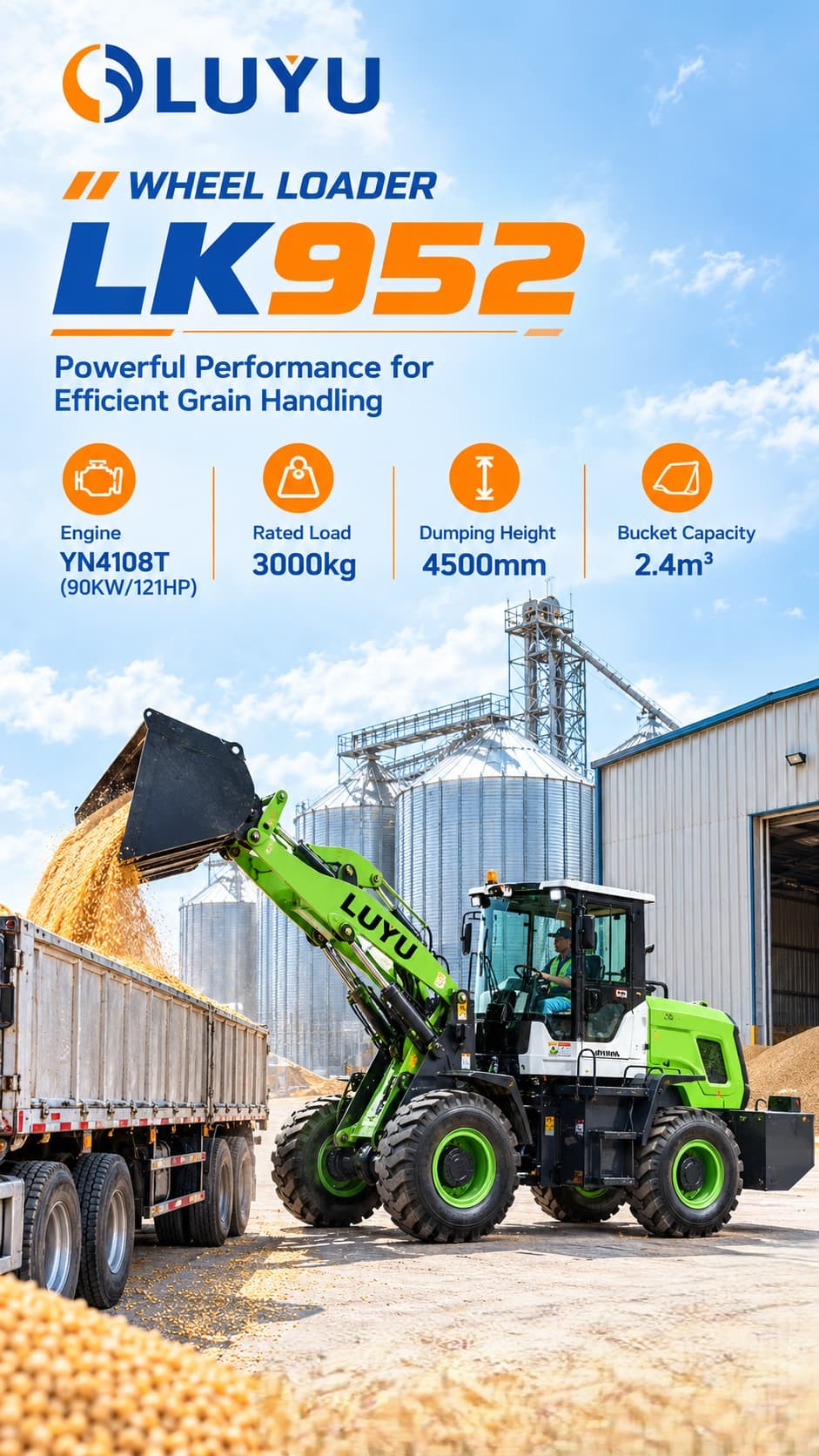
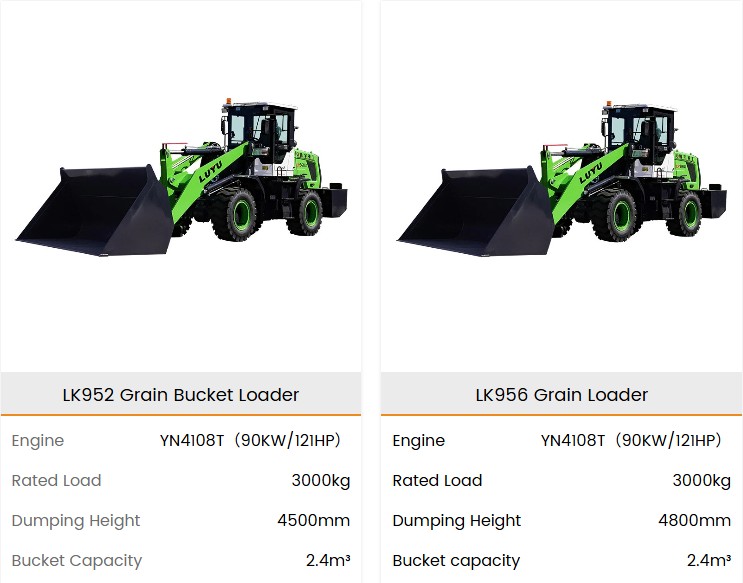
LUYU offers the LK952 and the LK956 grain bucket loader, two grain wheel loader models designed specifically for grain handling. Their configurations relate to the requirements above as follows.
Dedicated Grain-Bucket with Larger Volume
Both are equipped with 2.4 m³ grain buckets, and each has a rated load of 3000 kg. The bucket gives bulk grain ample volume, and the rated load delivers strong capacity in the specified setup. LUYU understands this: these figures give you the starting point for assessing the crop-handling machine.
Unloading Height
Our LK952 offers a dumping height of 4500 mm, and the LK956 offers 4800 mm. You have two unloading-height options within our 3000 kg rated-load range. Share the height of your receiving vehicle or hopper with us, and we'll help you identify the more suitable configuration.
Space Between Storage Areas
The two models have an overall width of 2650 mm. If you're not sure whether this is suitable for your storage, just share your aisle dimensions, and we’ll help check if the grain loader can fit through the space between grain piles, walls, or partitions.
Access for Routine Cleaning
Our side-opening hood provides access to the engine bay for routine checks and cleaning. This access supports the regular clean-downs that dusty grain-store work calls for.
Find a LUYU grain loader for your store, or contact our team with your crop, intended load per scoop, receiving-point height, and store layout. We can explain the relevant grain warehouse loader specifications and prepare a quotation for the proposed configuration.
Share to :




Inquiry
Our manager will contact you within 30 minutes of working hours.
Related products

Send Your Inquiry