






NEWS
Grain Loader Bucket Capacity: A Guide to Choosing the Right Size
Contents
1. The Bucket's Role in Grain Handling
2. Standard Buckets vs Grain Buckets
3. How to Choose a Suitable Grain Bucket
Grain bucket capacity is a key specification to compare when buying a loader for grain storage. But how does the volume listed in cubic metres translate into a load of grain? And why can the bucket be full before the loader reaches its carrying limit?
To choose the right grain loader bucket capacity, consider how the bucket will work throughout the job—from scooping grain at the pile to transfers within the store and truck loading.
We'll first explain its role and how grain buckets differ from standard buckets, then examine how the loader's rated load, available warehouse space and bucket shape guide your choice.
1. The Bucket's Role in Grain Handling
Loose grain has no fixed shape, so a grain loader relies on its bucket to gather, contain, and transfer it. The grain bucket's role spans three stages:
Pickup from the grain pile: The bucket scoops loose grain into one load, replacing repeated manual shoveling.
Transfer within the store: The loader can transport grain to the loading area or another storage location.
Discharge into a truck or hopper: The loader's arms lift the bucket, which then tips forward to release the grain into the receiving equipment.
The bucket is therefore central to daily grain handling. It enables one grain warehouse loader to complete pickup, transfer, and discharge, reducing intermediate transfers and manual loading and unloading.
2. Standard Buckets vs Grain Buckets
Standard buckets generally handle soil, sand, and gravel. However, grain has a lower bulk density, which means the same weight occupies more space. As a result, a standard bucket may therefore fill with grain before the loader's rated carrying capacity is reached.
A grain bucket offers more room for these lighter materials. Here is how the two compare:
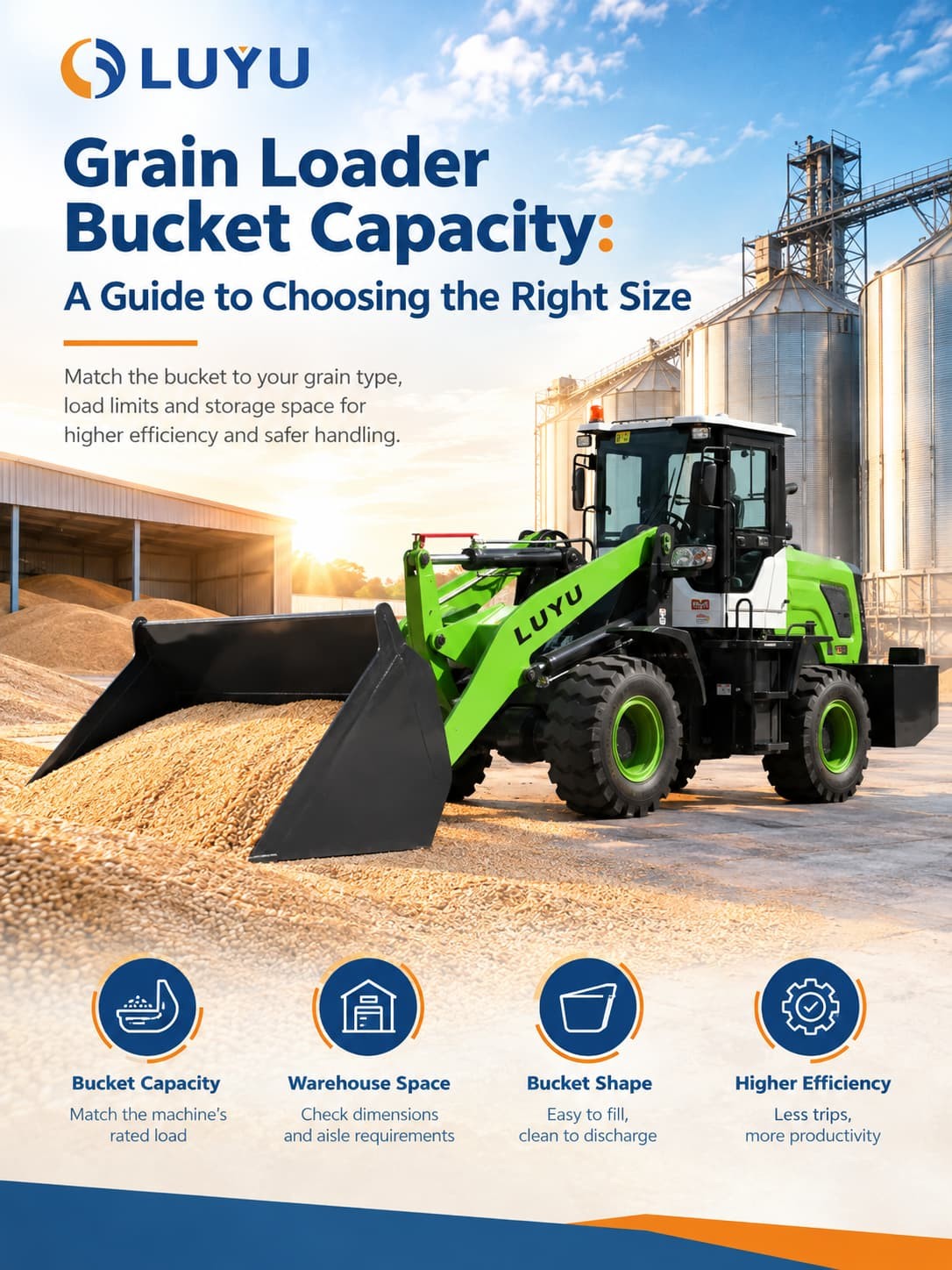
For equipment that mainly moves loose grain, a dedicated grain bucket is the better fit. We equip our LK952 and LK956 with 2.4 m³ grain buckets to increase grain bucket capacity for each scoop and reduce trips caused by insufficient bucket volume.
3. How to Choose a Suitable Grain Bucket
Set the Capacity Limit from the Loader's Rated Load
Even on a dedicated grain bucket loader, the grain in a full bucket must remain within the permitted load for that machine configuration.
Grain is relatively light and suits a larger bucket, but capacity cannot increase without limit. A bigger bucket adds its own weight and affects how the machine carries its load. For a new loader, the manufacturer’s matched bucket options offer a practical way to balance grain space and carrying capacity.
Our LK952 and LK956 both have a 3,000 kg rated load and come factory-fitted with 2.4 m³ grain buckets. The grain loader bucket capacity is matched to the machine’s load rating to retain an operating margin for loading, lifting, and tipping, and support safer handling.
Check Bucket Dimensions Against the Available Warehouse Space
Once the load requirement is met, check how large a bucket the grain store can accommodate.
Stored grain takes up floor space, leaving aisles for the loader to travel and turn. Establish those aisles and turning areas after grain is in place, then check the candidate bucket’s width and overall dimensions. Exclude configurations that would restrict access.
Similar grain bucket capacities may come in different shapes and sizes. If aisle width is limited, extra width cannot be the only way to gain volume. Compare bucket depth, height, and capacity, and confirm that the design is approved for the machine. That gives you a suitable capacity within the space available.
Assess Bucket Shape for Filling and Discharge
Once the capacity range is established, consider how readily the bucket fills and how easily the grain empties.
A high stated volume offers little benefit if the bucket is difficult to fill. Grain left inside after tipping also takes up space in the next load. Watch the full scoop-and-discharge cycle rather than judging the grain bucket capacity by its cubic-metre figure alone.
The grain buckets in our LUYU grain loader range have smooth inner surfaces and inclined sidewalls. Grain can slide towards the lip more readily, with less left inside after discharge. That puts the available bucket space to use during repeated handling, rather than simply increasing capacity on the specification sheet.
Conclusion
A suitable bucket must work with the loader’s rated load, warehouse space, and discharge requirements. Establish those conditions first, then compare grain loader bucket capacity to choose a grain loader for long-term use.
If you are buying equipment for a grain store, tell the LUYU team your main grain types, daily handling volume, and warehouse layout. We will explain the bucket and machine configurations for the LK952 and LK956 and prepare a clear quotation for you.
Share to :




Inquiry
Our manager will contact you within 30 minutes of working hours.
Related products

Send Your Inquiry