






NEWS
Brazil Grain Loaders: A Selection Guide for Soybean Handling Equipment
Contents
1、The material flow chain in Brazilian soybean storage, and where it congests
2、Grain loader selection — rule the machine out first, then compare output
Brazil is the biggest soybean producer on the planet, and for a few weeks a year that fact shows up in every yard and every buying station across the country. Trucks arrive together. Lines form outside the gates.
The real squeeze is timing. Soybeans come off the combine wet, and wet grain will not keep. It has to go through the dryer first. Rain inside the harvest window stops both jobs at once — no drying, no moving. Then trucks start lining up at the unloading bay, and the whole site settles into the pace of the slowest one in the queue.
A grain loader covers the gap that opens up. It gathers loose grain, moves it a short distance, and puts it in a truck.
1、The material flow chain in Brazilian soybean storage, and where it congests
In Brazil, soybeans are harvested by combine and then transported to collection points for weighing and sampling. After unloading, the grain is conveyed, cleaned, and dried before going into silos or temporary storage. From there, it is loaded onto vehicles for shipment.
There are three areas where bottlenecks are likely to occur.
The unloading bay. Through harvest, a lot of haul trucks arrive at the buying station at the same time. If the unloading positions are laid out badly, trucks cut across each other and everyone waits longer than they need to.
Inside the yard. Once the beans are off the truck, they still have to reach the dryer, the silo, or the pile. If the unloading area, the transfer route, and the pile positions don't connect cleanly, grain gets handled more than once. That extra handling is where the day gets away from you.
The loading point. Beans have to leave the site for the plant or the port. If loading can't keep pace with the trucks arriving, the next leg of the haul gets held up, and grain turns over more slowly on site.
So the real issue in Brazilian soybean handling is not whether you own enough machines. It is whether unloading, yard transfer, and loading fit together. That is also why a grain loader in Brazil earns its keep in the gap between those steps.
2、Grain loader selection — rule the machine out first, then compare output
Getting the ruling factors out of the way first is what makes a grain loader for soybean handling easy to specify, and easy to live with afterwards.
1. Unloading height (ruling factor).
For loading soybeans onto trucks in Brazil, unloading height is the first thing to check. The loader needs to reach into the truck bed with enough lift to spare. Otherwise, loading becomes difficult, and soybeans may spill over the sides. Keep in mind that the truck’s width and height limits are different from the grain pile height you need to reach. Measure the sideboard height of the trucks you actually use, then check whether the loader has enough lift remaining at that height.
2. Overall size and turning (ruling factor).
Overall width decides whether the machine gets through the yard lanes at all. Wheelbase and minimum turning radius decide whether it can work the unloading bay, the pile, and the loading area without getting boxed in. Look at the ground while you are there — level changes and potholes cause trouble that no spec sheet covers.
3. Bucket volume × bulk density (output factor).
Cubic metres on their own tell you very little. Weigh what a full bucket of your soybeans actually comes to, because the same bucket gives up different weights depending on the condition of the material and how tightly it is packed. Bucket capacity has to be read together with the weight sitting in the bucket.
4. Rated load (output factor).
Rated load and bucket volume have to be checked against each other. Estimate the weight per bucket from the crop you are handling, then confirm that the machine's rated load covers it. If you plan to add counterweight or swap attachments, the configuration and the load figures change with it — work through the numbers again instead of carrying the old conclusion forward.
5. Throughput and working frequency (output factor).
How much grain moves in a day, the hours the site is genuinely usable and the length of one round trip all bear on the machine count and on how the day gets scheduled. Settle what the handling job actually is first, then work out what a machine has to deliver on your ground. Round-trip time has to be timed on site, because how long loading, turning, travel and unloading takes depends on the yard layout, the width of the lanes and the routes your drivers take.
3、Which loader fits which job
Matching a model to the constraint is faster than reading a spec table row by row. Every grain loader for soybean handling job comes down to a handful of numbers, and those numbers are what the LUYU LK series grain loaders are built around:
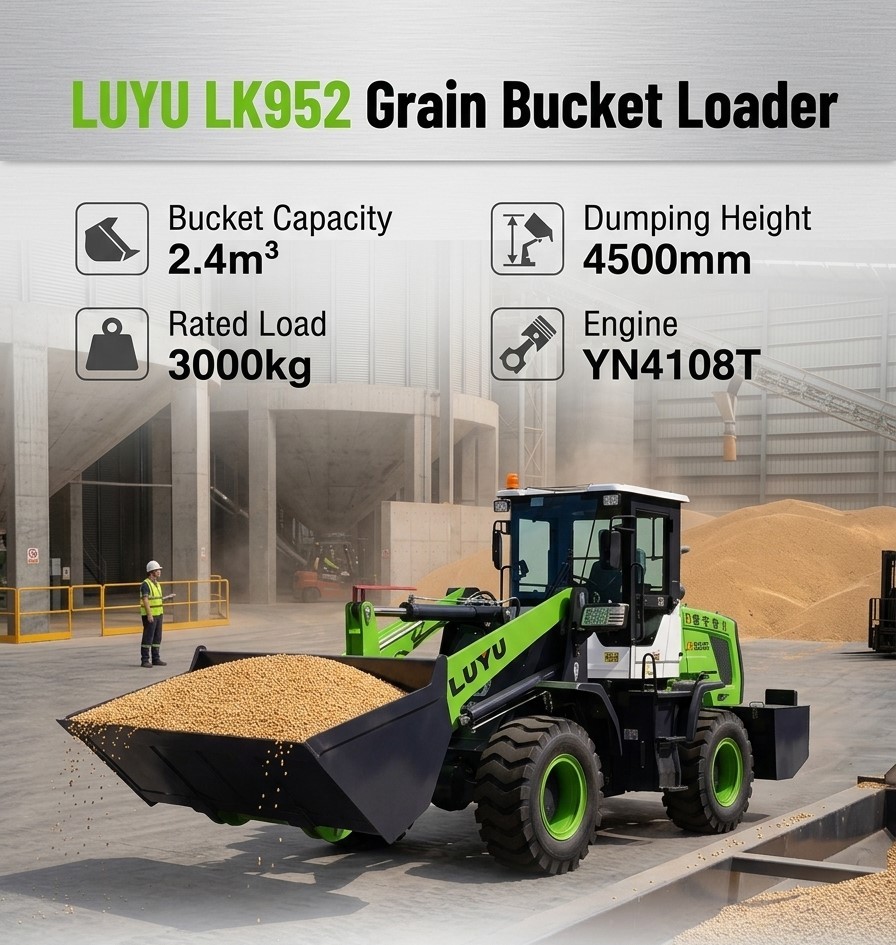
Ground pile → high-sided truck or semi-trailer: unloading height is the deciding number. At 4500 mm, the LK952 suits standard high-sided trucks; for taller sideboards or semi-trailers, go with the LK956.
Narrow yard lanes, frequent moves between jobs: look at turning ability and clearance. The LK952's 2720 mm wheelbase and 380 mm ground clearance let it reposition without fuss.
Unloading pit → dryer feed: steady continuous output and bucket width matter here. Both models carry the same 2.4 m³ wide bucket, which spreads the load evenly and cuts spillage.
4、Selection checklist
· Sideboard height of the target trucks, measured — is there enough unloading height?
· Narrowest lane on site — will the machine's width clear it?
· Does the unloading bay need a truck three-point turn — can the wheelbase and turning radius take it?
· What bulk density are you working with — how much does a loaded bucket weigh?
· Daily throughput, hours worked, and measured round-trip cycle — what are the real numbers?
· Where do spare parts come from, and can the local dealer service the machine?
Conclusion
Soybean storage in Brazil only works when each step hands over cleanly to the next. Getting more out of Brazilian grain handling means matching the machine to the job and getting unloading, piling, and loading to agree with each other. Start with the ruling factors — unloading height and overall size — then set the specification against the volume you actually move.
If you are looking for a grain loader for sale for a soybean site in Brazil, take a look at the LUYU LK series and pick the model against your own measurements. A grain warehouse loader is a long-term purchase, so the numbers should come from your yard rather than from a brochure.
Share to :




Inquiry
Our manager will contact you within 30 minutes of working hours.
Related products

Send Your Inquiry