






NEWS
Grain Warehouse Loader vs. Grain Conveyor: What's the Real Difference?
Contents
1. Where the difference actually lies
2. Why a wheel loader comes up when grain has to move around
3. Grain loader applications — when a loader is the right call
4. Do You Have to Choose One or the Other?
Grain doesn't move on its own. It has to get shifted off a truck, spread into a pile, then moved again when the next lot comes in — and eventually into whatever is hauling it out of the yard. Depots, collection points, and processing floors all deal with this every day, and the right piece of bulk grain handling equipment makes a visible difference to how the day runs.
A conveyor runs on a fixed line and doesn't stop. A grain warehouse loader works from a bucket, so it can pick grain up in one spot, drop it in another, and be somewhere else by lunchtime. Sounds like a small difference. It isn't. A conveyor only works where the grain already is. A loader works where the grain happens to be, and in a working yard that's rarely the same place twice running.
Here's how each machine works, the jobs it handles best, and the key specifications to check before buying.
1. Where the difference actually lies
The loader: grab it, move it, drop it
A grain loader picks grain up with a front bucket. It carries it somewhere. It tips it out — into a truck, into a feed point, or back onto a pile that's spread too thin. Three different jobs, one bucket, and the machine just drives over to wherever the next one is.
That's the appeal. A depot with grain sitting in four different spots needs a machine that can be in four different spots.
The conveyor: one line, running
A grain conveyor does one job every day. Grain comes in at one end, travels a set path, and comes out at the other. Receiving, bin and silo feed, the step before processing — wherever the route was worked out in advance, a conveyor is already the obvious answer.
In short, the difference is really about the shape of the work. Multi-position picking and flexible transfers? That's a grain warehouse loader. One continuous run? That's a conveyor.
2. Why a wheel loader comes up when grain has to move around
Grain piles don't stay where you put them. New stock lands somewhere else. The pile that needs flattening is never the one you drove past yesterday. And the truck isn't going to park itself next to the grain this time.
For a yard juggling pile shaping, short transfers, and truck loading at the same time, two things are worth weighing on a wheel loader for grain handling: how it moves, and how many jobs it can take on.
It goes where the grain is
Stockpiling areas and loading points are rarely neighbors. A grain wheel loader just moves — reposition, pick up, drive off, dump. None of that needs planning in advance.
The boring stuff matters more, though: aisle width, turning room, how the ground holds up. A machine carrying a full bucket on soft ground is a different problem from the same machine on concrete.
It covers more than transport
Hauling grain is only part of what a yard does. Piles need levelling. Loose grain scattered across a floor needs gathering. Material needs shifting fifty feet, not fifty yards. The bucket on a grain warehouse loader handles all of it, which makes one machine a good deal easier to schedule around than three.
It loads the truck
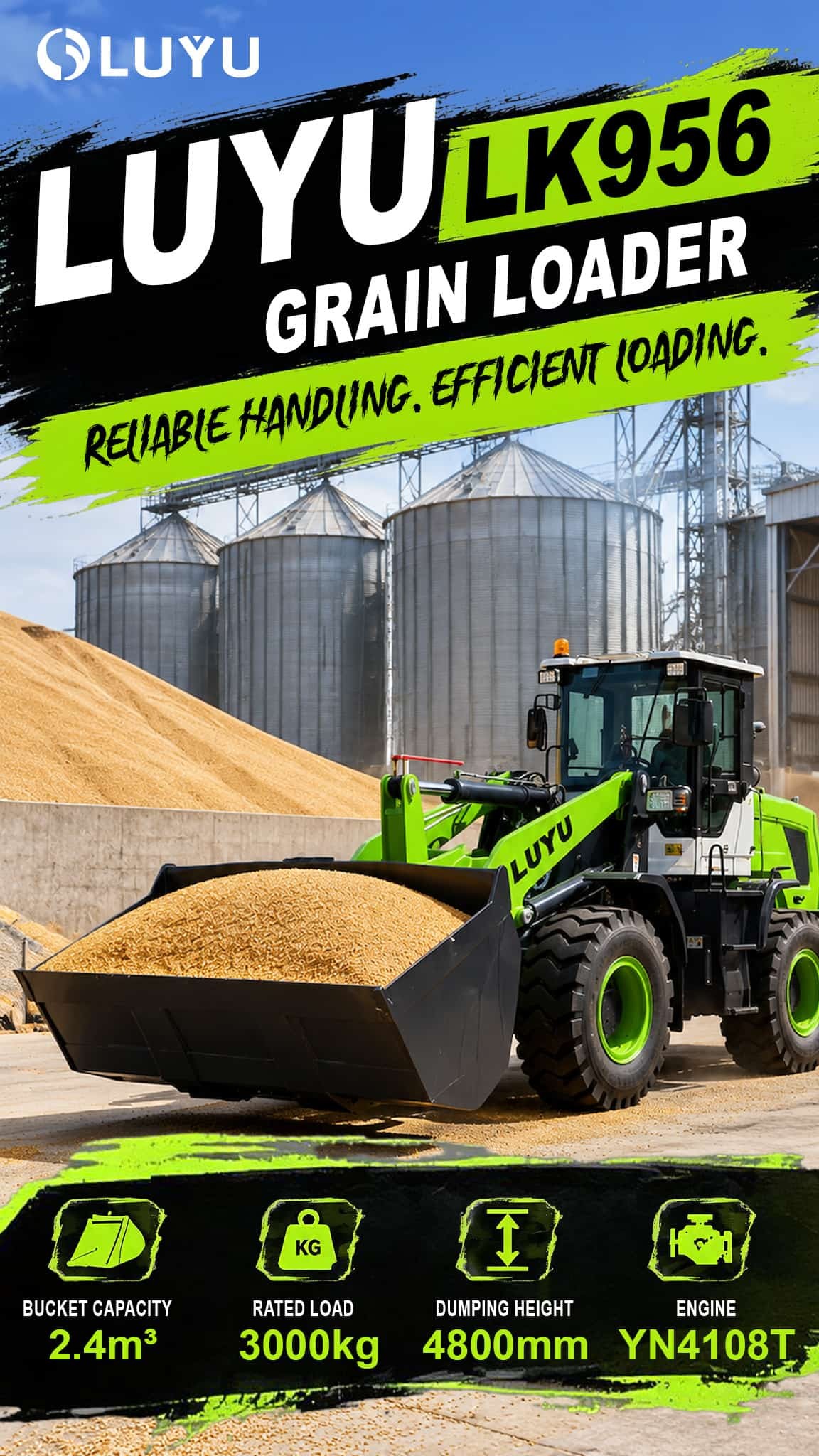
Moving grain from the pile into the truck bed is the reason most buyers ordered the thing in the first place. Bucket capacity, rated load, and maximum dump height are the three numbers to check against your actual loading job.
One trap here. Grain density and moisture content both affect how much a single bucket weighs, so bucket volume on its own won't tell you what the machine can really lift. That figure comes from the grain, not the brochure.
3. Grain loader applications — when a loader is the right call
Most of the grain loader applications worth thinking about come down to a handful of recognizable situations.
Situation one: the grain isn't in one place.
Pick-up points scattered across the shed, or a working position that shifts as stock comes in and goes out. Here, mobility is the whole argument, and a wheel loader for grain handling gives you it where a conveyor can't. A conveyor won't follow the pile.
Situation two: the daily work isn't a single task.
If your site needs more than grain transfer—levelling piles, gathering loose grain, or moving it short distances—look beyond conveying capacity. The bigger question is whether one machine can handle all these jobs.
Situation three: trucks are the destination.
If a good share of the day ends with grain going into a truck bed, then unloading height, rated load, bucket capacity, and working clearance are the specs to compare across machines.
Situation four: you'd rather not swap machines mid-shift.
Could one grain loader handle several jobs? If each task falls within the machine's rated limits, it may be worth considering. But the decision also depends on the workload, travel distances, and how the site is laid out.
4. Do You Have to Choose One or the Other?
Not really. A grain loader for grain warehouses can run alongside a conveyor instead of replacing it. The two can each take whichever part of the work suits them better.
Take a depot, for example. The loader handles the fetching. Grain sitting in different parts of the yard gets picked up and dropped at one designated feed point, and a grain loader covers the runs the conveyor line can't serve. From there the conveyor takes over, carrying it along the fixed route it was built for.
Whether that split makes sense comes down to a few numbers. Feed height has to line up with the conveyor inlet. Conveying capacity and daily throughput need to be big enough for the volume you're actually moving. Floor space counts too, since a loader now has to work in the same area as the conveyor line.
But if the conveyor already covers the continuous-flow part on its own, the purchasing focus for a grain warehouses loader shifts to the jobs the conveyor can't do at all. Picking up loose grain wherever it lies. Levelling piles down. Loading vehicles.
Conclusion
A conveyor solves continuous movement along a fixed line. A grain warehouse loader covers everything that needs wheels — moving between pick-up points, short transfers, pile levelling, truck loading.
Buying bulk grain handling equipment? Start with the task that fills most of your day. That's the one the machine has to be right for. Then work through the numbers. Bucket capacity and rated load decide how much you move in a run. Unloading height has to suit the trucks you load. And the space you've got to work in matters just as much.
Some yards need one machine that moves between locations and covers several kinds of bulk grain work in the same shift. If that's your situation, take a look at the LUYU grain loader for grain warehouses range. Compare the product configuration against what your actual operating requirements are, and you should be able to narrow it down to the right model.
Share to :




Tag :
Inquiry
Our manager will contact you within 30 minutes of working hours.
Related products

Send Your Inquiry