






NEWS
Brazil Tractor Market 2026: Current Situation and Market Trends
Contents
1. How Is the Brazil Tractor Market Performing? Domestic Sales Remain Under Pressure
2. How Are Tractor Sales Performing Across Different Horsepower and Drive Categories in Brazil?
3. What Factors Influence Tractor Purchasing Decisions Among Brazilian Farmers?
4. What Brazil Tractor Market Trends Are Worth Watching?
Brazil is one of the most significant agricultural machinery markets within Latin America. With large-scale commercial farming and various agricultural systems within the country, Tractors and Agricultural Machinery will continue to be in high demand. In 2026, there have been some changes in the Brazil tractor market. Local sales have been challenged by poor farm conditions, financing, and agricultural product prices.
Therefore, it may be more useful for Farmers, Agricultural Machinery traders, and importers to know what changes are taking place in Tractor demand. Based on your required Tractor HP, specifications, price, and service, it may be more useful for you to choose different models. With knowledge of the current Brazil Tractor Sales and how this market is developing, consumers can make more informed purchasing decisions.
1. How Is the Brazil Tractor Market Performing? Domestic Sales Remain Under Pressure
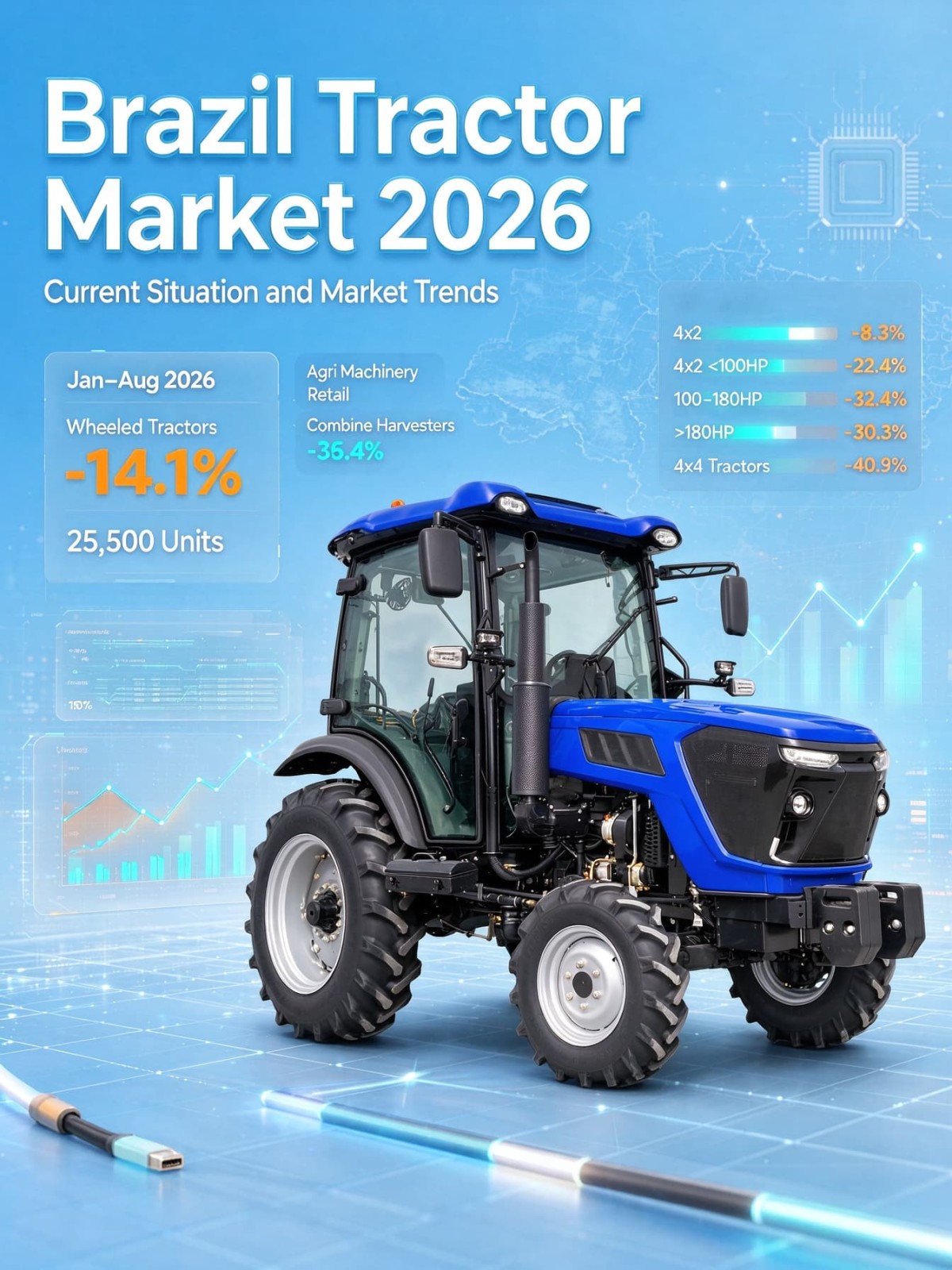
According to data released by the Brazilian National Association of Motor Vehicle Manufacturers (ANFAVEA), the retail sale of wheeled tractors decreased by 14.1% in Brazil during the first eight months of 2026 to 25,500 units, down from 29,700 units in the same period in 2025.
Overall, retail sales of agricultural machinery in Brazil decreased by 15.8% to 27,000 units in the first eight months of 2026. The sales of combine harvesters decreased by a greater margin, down to 1,400 units from around 2,300 units in the same period in 2025 (-39.4%).
The data shows a decline across the sector, with multiple types of agricultural machinery suffering from lower sales. Even the tractors, which are a key part of daily farming, have suffered.
This is due to the issues in agriculture. The high cost of financing and increasingly large debt burden farmers face, combined with the volatile prices of agricultural commodities, can all impact the amount of cash farmers have available. With buying new machinery requiring them to spend more money, some farmers may be putting off buying new machinery.
2. How Are Tractor Sales Performing Across Different Horsepower and Drive Categories in Brazil?
Looking at ANFAVEA sales data for January to August 2026, we can see there are variations in the levels of sales decline for different tractor types within Brazil.
There was an 8.3% year-on-year decline in 4×2 tractor sales where the engine power was less than 100HP.
• A 22.4% decline for those 100-180HP.
• 30.3% for greater than 180HP.
• A 40.9% fall for 4×4 tractors.
Clearly, there has been a significant fall in sales for 4×4 tractors compared to the other options, meaning we can see sales pressure isn't just affecting different power ranges but different drive options.
However, the above data is split out into different ranges based on the power and drive type, meaning we can't see how the 4×4 have done within any specific power range.
3. What Factors Influence Tractor Purchasing Decisions Among Brazilian Farmers?
With the market for tractors being pressured, and different levels of performance depending on the horsepower, Brazilian farmers must be more aware when investing in equipment.
Interest rates can play a key part in tractor purchases. If farmers are needing to finance the purchase of equipment, they may plan to replace or improve their equipment based on the interest rates and repayment periods.
Profitability can also play a key part. When prices of agricultural commodities fluctuate, it can increase production costs and pressure debt. This means farmers are more likely to be conscious of getting a good return on investment.
The cost of running a tractor in the long term can have an impact. The engine will need regular maintenance and servicing. Availability of spares, ease of repair and after-sales technical support can all impact how much it costs to run.
This means, when purchasing a tractor, you should consider the Total Cost of Ownership (TCO). ANFAVEA has pointed out that when purchasing agricultural equipment for public procurement, it should be considered.
4. What Brazil Tractor Market Trends Are Worth Watching?
Based on market performance in 2026, several Brazil tractor market trends deserve attention in the coming years.
Firstly, imports continued to shape the industry. Total Brazilian agricultural machinery imports increased by 42% between January and September of 2026. Tractor imports from China increased by 117% during this time. This highlights that imported equipment is increasing in the market. Please note that the first statistic is for all agricultural machinery, whereas the second is for tractors only from China.
Secondly, public procurement is an interesting sector. During 2025, there were 3318 tenders for agricultural tractors on Brazil’s public procurement platform. Of these, around 65% were for imported equipment. This demonstrates how much imported equipment is being purchased through government procurement. As a result, it is an additional area manufacturers and suppliers should consider.
Thirdly, finance for equipment replacement is limited. In the 2026/2027 Plano Safra agricultural finance programme in Brazil, the budget for Moderfrota (which provides specific support for tractor and combine harvester purchases) has reduced by 53.9% year on year at 12.5% interest. This change in finance could impact farmers’ decisions to purchase new equipment.
Finally, the market may stabilise in 2027. Abimaq believes there may have been a short-term low point in the Brazilian agricultural machinery market in 2026. They expect stability or slight improvements in 2027. However, slow improvements will rely on profitability at farms as well as finance and farmers’ ability to invest in equipment.
Conclusion
According to ANFAVEA's President Igor Calvet, when acquiring machinery through public procurement, it is important to consider factors beyond the lowest price. Spare parts, post-sale service, technical assistance, and overall costs can all play an important role. For imported brands, having spare parts, warehousing and technical assistance available locally can be an important factor in gaining market share.
LUYU supplies agricultural 4×4 tractors between 25 and 260 CV in Brazil. With their local warehousing, spare parts centre, and technical assistance team, they are able to supply their equipment, spare parts, and technical assistance.
Buyers are placing increasing weight on factors such as choice of products, appropriateness of equipment, and quality of continuing support in the Brazil agricultural tractor market. Suppliers who satisfy these considerations will be best placed to compete effectively within this market.
Data sources: https://anfavea.com.br/site/imprensa-noticia/anfavea-maq-outubro-2026
Share to :




Tag :
Inquiry
Our manager will contact you within 30 minutes of working hours.
Related products
 OXT504 50HP Tractor
Rated Power(kw/hp) 37/50 Gear box (forward/backward) 8+8 Tyre (Front/Rear) 6.5-16/11.2-24 Rotating Speed of PTO Shaft(rpm) 540/720  OXT1004 100HP Tractor
Rated Power(kw/hp) 73.5/100 Gear box (forward/backward) 12+12 Tyre (Front/Rear) 8.3-24/14.9-30 Rotating Speed of PTO Shaft(rpm) 540/760  OXT804 80HP Tractor
Rated Power(kw/hp) 66.2/80 Gear box (forward/backward) 12+12 Tyre (Front/Rear) 8.3-24/14.9-30 Rotating Speed of PTO Shaft(rpm) 540/760  OXT2004 200HP Tractor
Rated Power(kw/hp) 147/200 Gear box (forward/backward) 24+8 Tyre (Front/Rear) 14.9-26/18.4-38 Rotating Speed of PTO Shaft(rpm) 540/1000

Send Your Inquiry