






China's Loader Exports Expand Globally in 2026, with Overseas Demand Reaching New Heights
In June 2026, China has exported 21,777 front-end loaders, according to customs data. That marks a 59.41% surge year-on-year. The Growth rate has now remained above 20% for 12 consecutive months. This signals strong and sustained momentum. And the cumulative export value reached RMB 2.381 billion, with a 31.13% rise year-on-year. It also makes eight consecutive months above 10%.
The half-year numbers show the same trend. Cumulative exports surpassed 100,000 units, a year-on-year increase of 56.67% year-on-year. The result? Total export value climbed to RMB 16.237 billion, up 24.8% year-on-year.
Notably, loader export value grew at a significantly slower pace than volume, indicating a decline in the average unit price.
By country, the United States stayed firmly in the top spot by volume, with 28,656 units exported — up a massive 139.7% year-on-year. That said, the average weight of these loaders came in at just 1,296 kg, meaning they're almost entirely 1-ton mini loaders bought mainly for home use.
Brazil moved up three places to second. Exports to the country totaled 4,963 units, up 60.3% year-on-year. The average machine weight was 7,986 kg, maybe mostly to 4- and 5-ton models.
Germany and Kazakhstan also topped the 4,000-unit mark, with growth of 37.9% and 14.1%, respectively. But here's the striking contrast: average machine weights stood at just 2,622 kg for Germany versus a hefty 8,252 kg for Kazakhstan.
Exports to Russia rose 13.4% year on year to 3,983 units, just below the 4,000-unit mark. Canada, meanwhile, surpassed 3,000 units, surging 72.1% year-on-year.
Vietnam, Poland and Australia all reached more than 2,000 units. Rankings moved up and down, but volumes rose in all three.
Additionally, exports also exceeded 1,000 units in 17 other countries, including the Netherlands, Sudan, and Libya. Except for the UK, Sweden and Argentina, exports to the rest of these markets consisted primarily of large-tonnage loaders, whose average weight exceeded 10 tons.
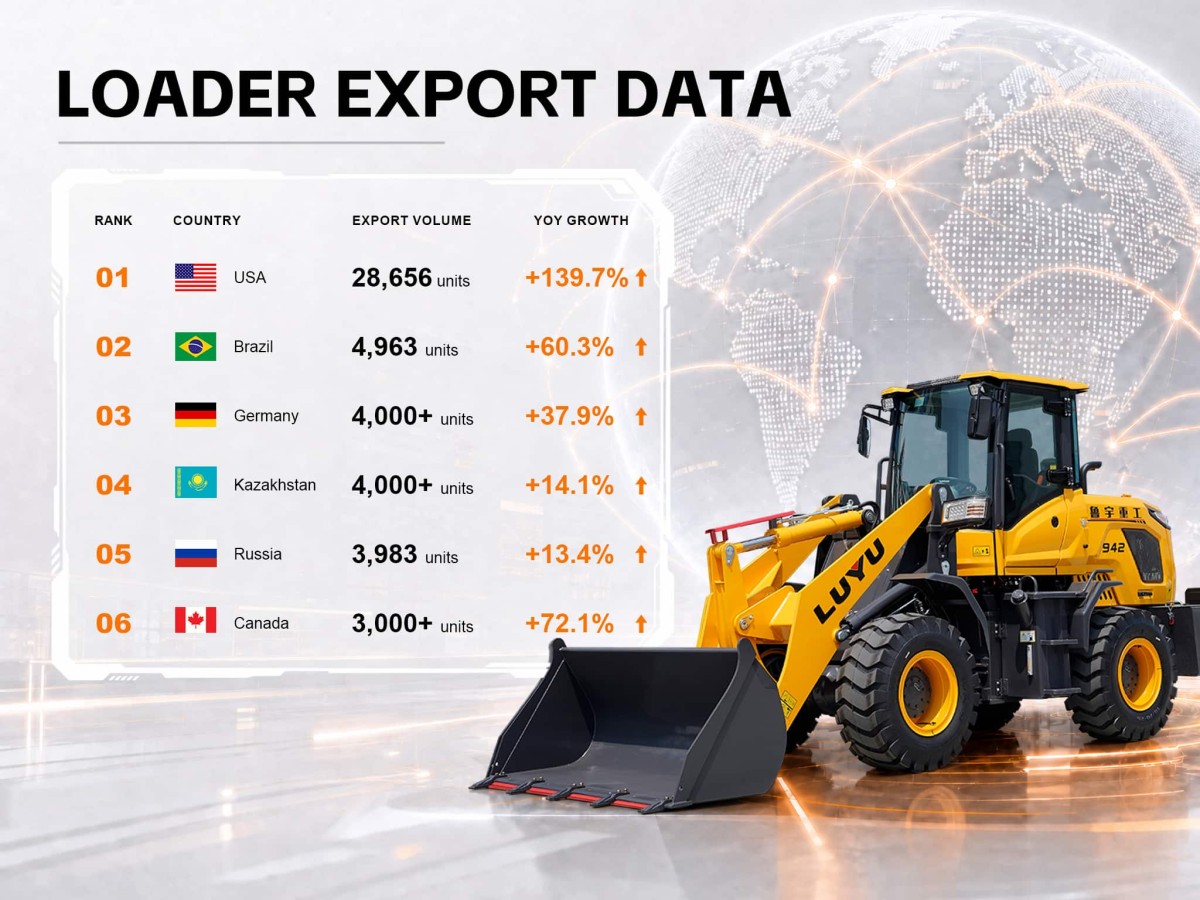
Overall, 26 countries imported more than 1,000 Chinese loaders in the first half, a sharp rise from 17 a year ago. Combined exports to these markets reached 78,455 units, accounting for 73.9% of China’s total loader exports.
In terms of export value, China's loader exports to the United States reached RMB 1.11 billion in the first half, ranking first among all destination markets. The average export value per unit, however, fell to RMB 39,000 — the lowest among the top 20 markets. This was less than half the RMB 80,000 recorded a year earlier.
Brazil ranked second with RMB 820 million, with an average unit price of RMB 165,000. Russia was third at RMB 790 million, averaging RMB 197,000 per unit. Then came Belgium — just 1,033 units shipped, only 22nd by volume — yet it claimed fourth by value at RMB 640 million. The reason? A stunning average price of RMB 616,000 per machine.
Kazakhstan came fifth at RMB 550 million. Five other countries, including Germany and Australia, cleared 400 million. Exports to six countries, including Turkey and Indonesia, also exceeded RMB 300 million. And another ten, such as Mexico and Uzbekistan, all broke the RMB 200 million mark.
Türkiye stood out despites its limited shipment volume. Only 540 units were exported to the market. But it still ranked 11th in value at RMB 380 million. Its average unit price was the highest at RMB 701,00. Japan followed at RMB 619,000. That means, both saw average prices slip from last year’s levels.
From 7,920 kg to 6,700 kg, average loader weight fell 15.41% from a year ago. The average unit price dropped even more, falling 20.33% from RMB 192,000 to RMB 153,000. But takes out the US data, then the store shifts. Average weight decreased just 5.09%, from 9,165 kg to 8,698 kg. Similarly, the average unit price fell 9.61%, from RMB 216,000 to RMB 195,000.
In general, China's loader exports varied significantly across regions, with wide differences in product weight and pricing. The average unit weight of loaders exported to Libya was 11 times that of shipments to the United States. In terms of price, the average unit value for Türkiye was 17 times the US level.
In conclusion, China's loader exports have maintained rapid growth for 12 consecutive months, reflecting steady expansion in overseas markets. At the same time, the steady slide in average export prices is a red flag that can't be ignored. Therefore, Chinese exporters need to stop competing on price alone. Investing more in R&D, better manufacturing, and higher-tech products matters a lot. Competing in overseas markets through reliable quality rather than low prices will help prevent excessive domestic competition from spreading abroad and support the long-term, stable growth of China's construction equipment exports.
Share to :


Tag :
Inquiry
Our manager will contact you within 30 minutes of working hours.
Related products
 LY949 Compact Wheel Loader
Engine YN4108T 90KW/122HP Rated Load 2800kg Dumping Height 3800mm Bucket Capacity 1.2m³  LY946 Mini Wheel Loader
Engine YN48T 92KW/123HP Rated Load 2500kg Dumping Height 3500mm Bucket Capacity 1.1m³  LY942 Compact Wheel Loader
Engine Type YN 76KW/103HP Rated Load 2200kg Dumping Height 3500mm Bucket capacity 1m³  LY919F Wheel Loader
Engine YN25 37KW/50HP Rated Load 1000kg Dumping Height 2600mm Bucket capacity 0.25m³

Send Your Inquiry